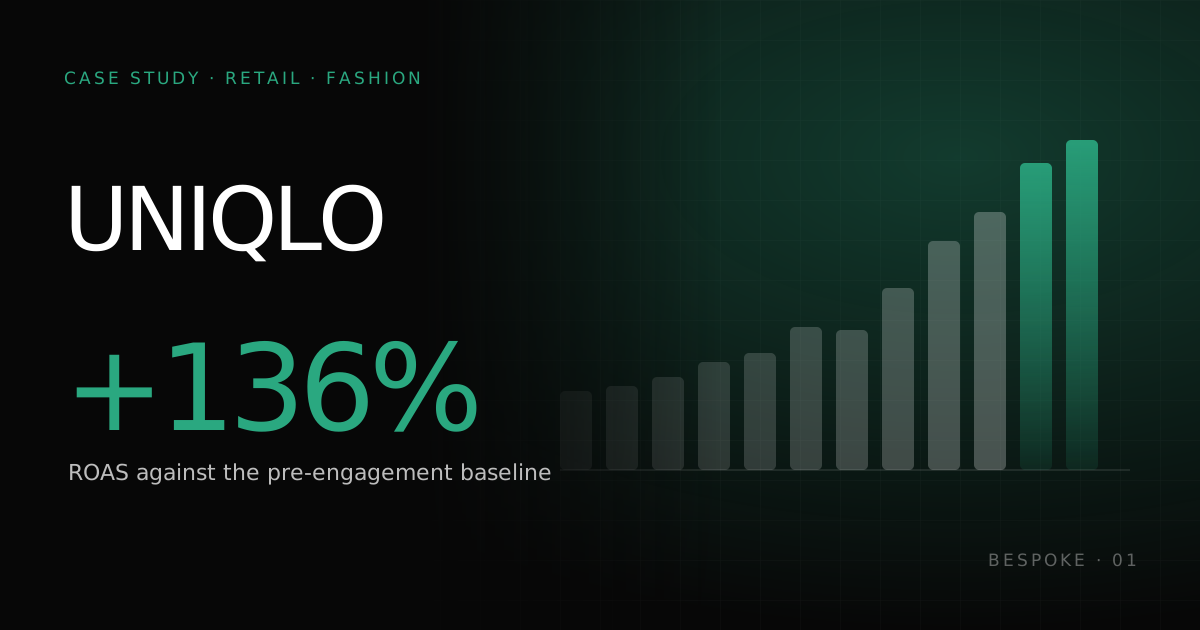
+136%ROAS against the pre-engagement baseline
-28%Cost per transaction on competitive generic clusters
+19ppShare of revenue from non-brand search
The challenge
UNIQLO had a strong digital presence in Vietnam, but paid search efficiency had not kept pace with its scale. The issue was not budget. It was signal quality and structural complexity.
- Signal noise. GA4 and Google Ads were misaligned, Enhanced Conversions and Consent Mode v2 were not fully in place, and minor events were mixed with primary conversions.
- Structural sprawl. Brand and generic campaigns competed with each other and starved high-potential terms of budget.
- Feed and creative gaps. Shopping titles were not led by product features, GTIN coverage was incomplete and responsive search assets were too broad.
- Experience friction. Mobile pages missed Core Web Vitals targets, which held back conversion.
What we built
- Data and measurement. Rebuilt GA4 e-commerce with Enhanced Conversions and Consent Mode v2. Primary conversions (purchase, revenue, new-customer flag) were separated from observe-only events, and naming was cleaned up to support data-driven attribution and lifetime value analysis.
- Account architecture. Isolated brand budgets and rebuilt generic, category and feature campaigns. Broad match ran with shared negative lists and exact-match anchors, and ad assets were pinned by value proposition: fabric, fit, UV protection and season.
- Performance Max and Shopping. Asset groups by category, such as AIRism, HEATTECH and UV Cut, with audience signals from GA4, CRM and lifetime value data. The feed moved to feature-first titles with full GTIN coverage, merchant promotions and price monitoring.
- Creative and experience. YouTube ran a reach, engage, act sequence with frequency caps and brand safety. Landing pages were tuned to load the main content in under 2.5 seconds and respond in under 200 milliseconds.
- Budgeting and governance. Portfolio target ROAS with margin guardrails by category. Budget moved by marginal return and lost impression share, with a weekly cadence of search-term reviews and experiments.
Results
Figures are adjusted under NDA. The direction and scale are accurate.
- Return on ad spend up 136% against the baseline.
- Cost per transaction down about 28% on competitive generic clusters.
- Non-brand revenue share up 19 percentage points.
- New-customer rate up 14%.
- Budget-limited lost impression share reduced materially across ten core terms.
What we learned
- Consolidating structure often beats adding campaigns.
- Feed quality (titles, GTINs, promotions) drives a large share of Shopping and Performance Max results.
- Margin guardrails and new-customer goals are what make broad match and Performance Max work.
- Core Web Vitals affect both ad rank and conversion rate.
The engagement ran on a weekly steering meeting, monthly business reviews and a quarterly strategy reset.
Notes
Figures are as published by Bespoke Marketing. Where a client relationship is under NDA, values are adjusted; methods and operating model are unchanged.